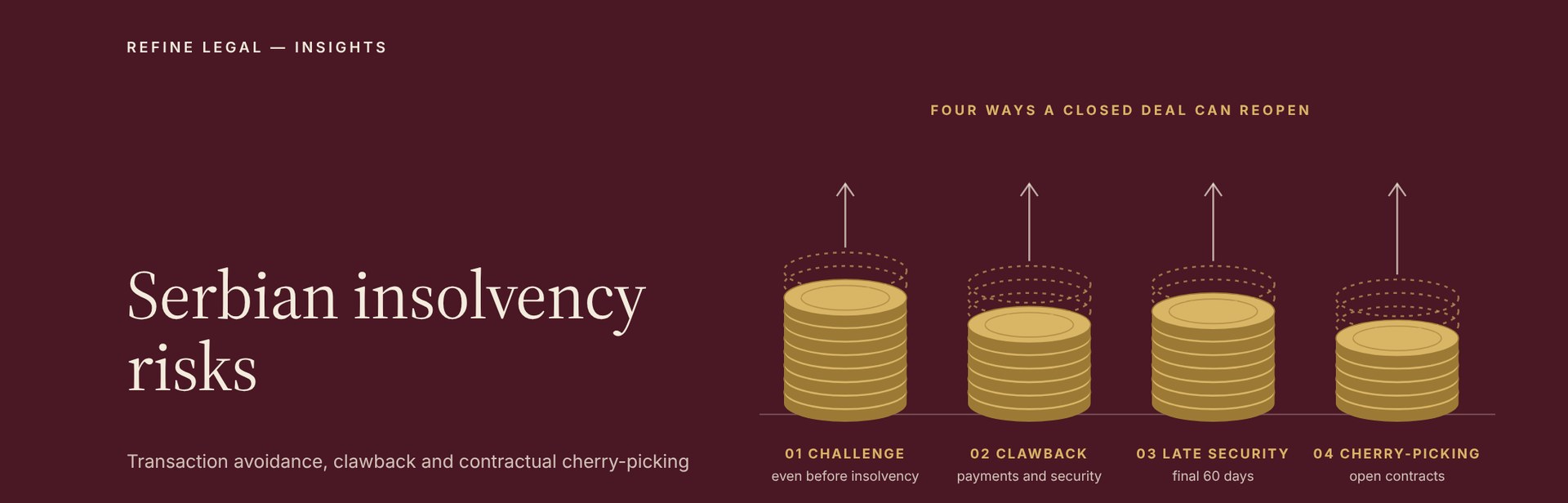
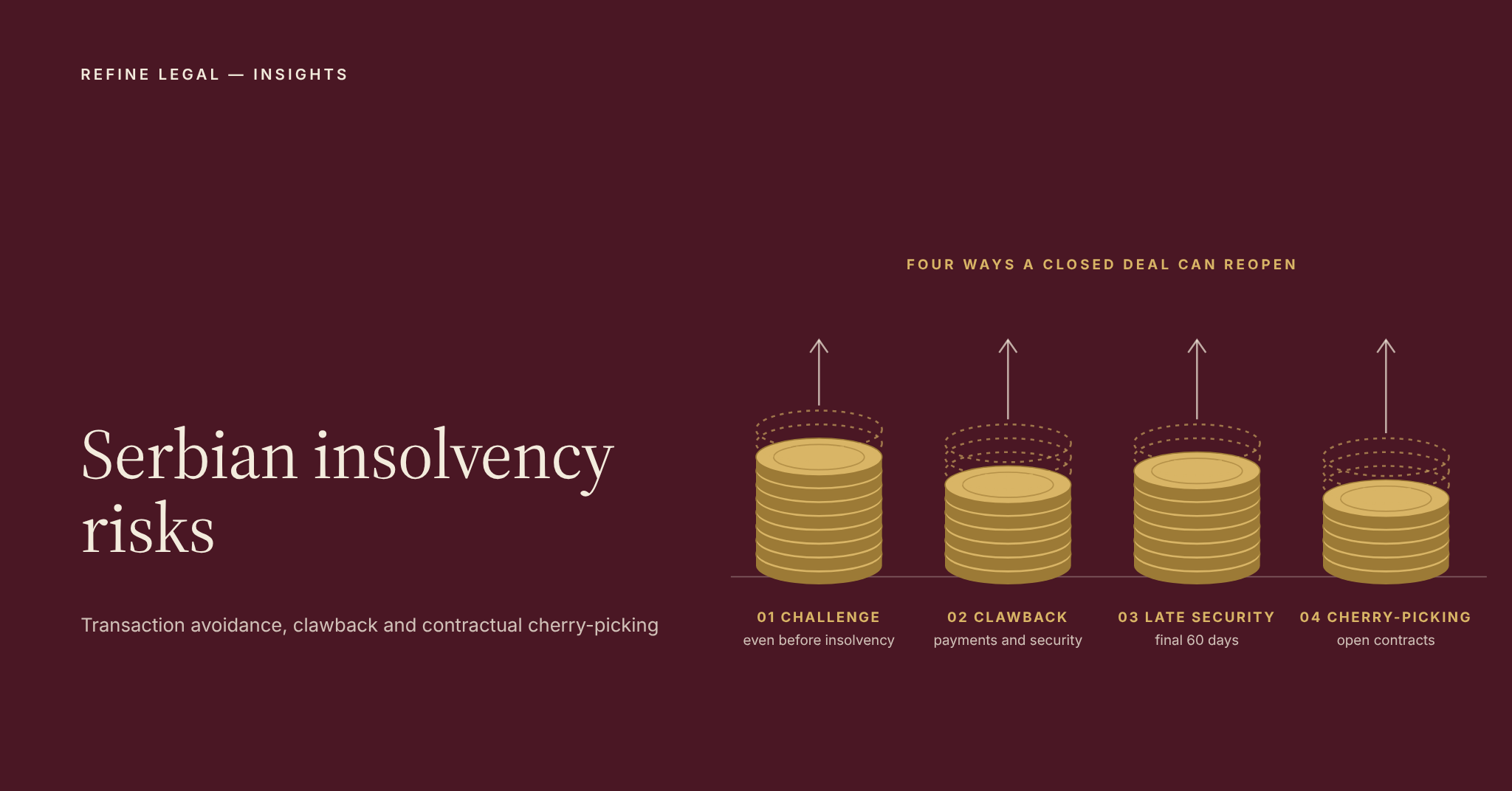

Financial distress of a Serbian counterparty does not necessarily mean that transactions already completed are beyond challenge, or that existing contractual arrangements will continue to operate as agreed.
Serbian law provides creditors and insolvency administrators with several mechanisms that may affect transactions entered into before insolvency, payments already received and contracts that remain outstanding when insolvency proceedings commence.
Three aspects of this framework are particularly relevant to lenders, investors and commercial counterparties dealing with Serbian businesses.
Creditors can challenge transactions even outside insolvency
Under Articles 280–285 of the Serbian Obligations Act (Zakon o obligacionim odnosima), a creditor whose claim has fallen due may challenge transactions undertaken by its debtor to the creditor’s detriment, even if no insolvency proceedings have been commenced.
This remedy, commonly known as actio pauliana, is available where the debtor’s action leaves insufficient assets to satisfy the creditor’s claim.
For transactions involving consideration, the creditor must generally establish that the debtor knew or could have known that the transaction would prejudice creditors and that the beneficiary knew or could have known the same.
Different rules apply to gratuitous transactions and equivalent arrangements, where the statutory evidentiary requirements are more favourable to the challenging creditor.
The time limits are:
- One year for transactions involving consideration subject to the general knowledge requirements.
- Three years for gratuitous transactions and other cases subject to the special rules.
Importantly, a successful challenge does not automatically invalidate the transaction for all purposes. Instead, it renders the transaction ineffective against the challenging creditor, and only to the extent necessary to satisfy that creditor’s claim.
This distinction is particularly relevant to asset disposals, intra-group transfers and transactions involving debtors facing financial difficulties.
Insolvency opens a broader clawback regime
Once insolvency proceedings are opened, Articles 119–130 of the Serbian Insolvency Act (Zakon o stečaju) allow certain transactions and actions undertaken before insolvency to be challenged where they prejudice creditors or favour particular creditors over others.
The insolvency administrator and creditors may bring avoidance claims, subject to the applicable statutory conditions.
The principal grounds include:
- Ordinary preference (six months): Payment or security provided in accordance with the creditor’s entitlement, where the debtor was unable to pay and the creditor knew or ought to have known.
- Unusual preference (12 months): Payment or security which the creditor was not entitled to receive, or not in the manner or at the time provided.
- Direct prejudice to creditors (generally six months): Transactions directly harming creditors, subject to the applicable statutory conditions.
- Intentional prejudice (five years): Transactions intended to harm creditors, where the counterparty knew of that intention.
These periods generally run backwards from the filing of the insolvency petition. Certain grounds also extend to transactions undertaken after that filing.
The legislation additionally contains specific rules on related-party transactions, including security and repayments involving shareholder or affiliated financing.
The practical consequence is that even a payment validly received, or a security interest validly established, before insolvency may subsequently become vulnerable to challenge.
If an avoidance claim succeeds, the challenged transaction becomes ineffective against the insolvency estate, and the beneficiary must return the economic benefit received. Any corresponding claim against the debtor may then be pursued in the insolvency proceedings.
The regime is not absolute. Article 126 provides important statutory protections, including for certain transactions supported by equivalent contemporaneous consideration and qualifying financial arrangements.
Security obtained shortly before insolvency requires particular attention
Article 49 of the Insolvency Act provides a separate rule for security rights acquired through enforcement or security proceedings during the final 60 days before the opening of insolvency proceedings.
Such rights cease to be effective as preferential rights, with the affected creditors losing their corresponding secured-creditor status.
This rule operates separately from the ordinary clawback framework and is particularly important when creditors seek additional protection against a deteriorating debtor.
The timing, legal basis and method of obtaining security may therefore be as important as the security documentation itself.
Insolvency administrators may elect whether to perform outstanding contracts
Article 94 of the Insolvency Act gives the insolvency administrator a choice where a bilateral contract remains wholly or partly unperformed by both parties when insolvency proceedings open.
The administrator may elect to perform the debtor’s obligations and require performance from the counterparty, or decline further performance.
This is commonly referred to as the insolvency administrator’s cherry-picking right.
The distinction has significant consequences:
- If the administrator declines performance, the counterparty may pursue its resulting claim as an unsecured insolvency creditor.
- The counterparty may formally request the administrator’s position, in which case the administrator must respond in writing within 15 days.
- If the administrator elects performance but subsequently ceases to perform, the resulting claim is treated as a liability of the insolvency estate, rather than an ordinary unsecured insolvency claim.
The rule may be relevant to outstanding acquisition agreements, supply arrangements, service contracts and other commercial agreements involving continuing mutual obligations.
However, its application depends on the contractual obligations outstanding at the opening of proceedings. It should not be assumed that Article 94 enables an administrator to reverse a transaction merely because it was completed before insolvency or subsequently appears commercially unfavourable.
The Insolvency Act also provides specific rules for certain types of contracts, which must be considered separately.
Banks are subject to a separate insolvency regime
The Serbian Act on Insolvency and Liquidation of Banks and Insurance Companies (Zakon o stečaju i likvidaciji banaka i društava za osiguranje) provides a specific framework for regulated financial institutions.
Under Article 14, avoidance actions concerning preferential transactions are subject to distinct rules, including:
- A six-month look-back period for relevant transactions.
- A one-year look-back period for transactions involving related parties.
- A requirement to bring the avoidance claim within 12 months from the date on which the legal consequences of insolvency proceedings commence.
These rules must be distinguished from the broader avoidance periods applicable to ordinary commercial companies.
The general Insolvency Act applies to bank insolvency proceedings only to the extent that the special legislation does not provide otherwise.
Financial collateral arrangements benefit from special protections
The Serbian Financial Collateral Act (Zakon o finansijskom obezbeđenju) provides important exceptions to the general insolvency framework.
For qualifying financial collateral arrangements between eligible counterparties, Articles 17 and 18 protect contractual close-out netting, collateral enforcement and certain transactions undertaken shortly before insolvency.
In particular, qualifying collateral arrangements cannot be challenged solely because the collateral was provided within a prescribed period before insolvency or because the secured obligation arose earlier.
These protections are particularly relevant to repo transactions, derivatives and other financial market arrangements.
However, eligibility is critical. Both counterparties must satisfy the statutory requirements under Article 4. Ordinary Serbian commercial companies generally fall outside this framework unless they independently qualify.
The protection is also not an unconditional exemption from all insolvency avoidance rules. Article 18 preserves the application of those rules to the extent they are consistent with the Financial Collateral Act.
Consequently, contractual close-out and netting arrangements involving ordinary corporate counterparties may require a materially different insolvency analysis from equivalent arrangements involving eligible financial institutions.
Practical implications for creditors and investors
Serbian avoidance and insolvency rules have implications well before any formal insolvency filing.
For lenders and secured creditors, particular attention should be paid to the timing of repayments, security perfection and additional collateral obtained from financially distressed borrowers.
For M&A investors, the analysis should distinguish between the completion of a share or asset transfer and any continuing contractual obligations which may remain outstanding if a party subsequently enters insolvency.
For commercial counterparties, the critical questions include whether a transaction may be challenged outside insolvency, whether payments already received could be recovered and how outstanding contractual obligations would be treated following the opening of proceedings.
The central consideration is that contractual validity, completion and insolvency protection are separate legal questions. A transaction may be valid and fully enforceable when entered into, yet remain exposed to statutory avoidance rules if the counterparty’s financial position subsequently deteriorates.
Understanding these distinctions at the structuring and documentation stage can materially reduce the uncertainty associated with a Serbian counterparty’s financial distress.
This article is general information, not legal advice. For an assessment of your specific matter, contact the Refine Legal team.